From Derelict Estate to Sustainable Social Housing
Posted on 21 July 2026
Introduction
When we look at derelict buildings, often demolition seems the only viable solution. Broken windows, stripped interiors, and years of neglect can make the option of re-using buildings appear unworkable.
But a site at Hospital Close in Leicester tells a different story. Rather than opting for site clearance, the council has chosen to restore the buildings, transforming the dilapidated housing estate into 110 modern, energy-efficient social houses. The project is proof that with the right investment, and technical and planning expertise, existing buildings can be a more sustainable alternative to demolition.
The Rise and Decline of Hospital Close
Hospital Close was originally developed in the 1970s to house NHS workers and their families, due to its proximity to Leicester General Hospital. Unusually, the blocks weren’t all identical, as different construction methods were applied across the estate, meaning that the refurbishment works proved rather more complex than those of a typical housing development.
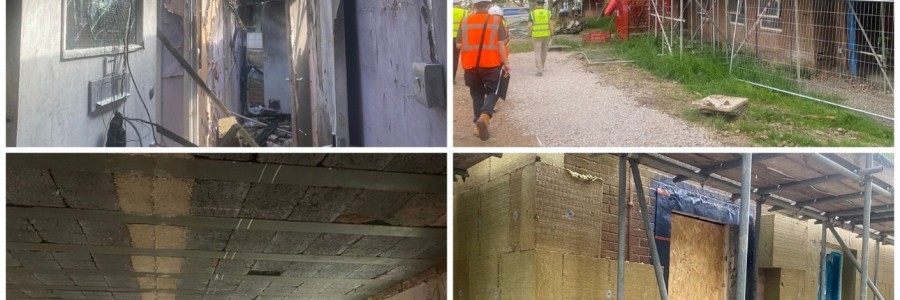
The estate was finally vacated in 2019 after the NHS Trust concluded that the cost of bringing the houses up to modern standards could not be justified. In the years that followed the empty site was vulnerable to vandalism, anti-social behaviour and fire damage. By the time the redevelopment works had begun, many of the buildings were in an extremely poor condition and had sustained significant structural damage.
Hospital Close was now effectively a ‘ghost estate’: a term used to describe housing estates that have been wholly or largely abandoned, particularly if they have been left vacant for a long period of time. Once houses have been abandoned, urban decline sets in very quickly because they are easy targets for vandalism, fly-tipping, arson and other criminal behaviour. The absence of an active community around them also creates a cycle of neglect that can make regeneration increasingly difficult and expensive.
Why Reuse instead of Demolition?
Rather than demolishing the estate and beginning all over again from scratch, the existing buildings are now being stripped back to their original structures, before being repaired and upgraded to modern standards.
200mm external wall insulation, triple-glazed windows, air source heat pumps, and photovoltaic (PV) panels are all being installed, to create a fully electric development. All of these measures combined should achieve an EPC ‘A’ rating; a prerequisite to securing grant funding through the Sustainable Homes Development Fund.
The retrofit is being delivered in line with PAS 2030 standards, to ensure that the energy efficient improvements will be installed in accordance with recognised best practice, while delivering long-term performance for the estate’s new residents.
Retention of the existing buildings will also deliver significant environmental benefits. Every building contains embodied carbon, generated through the extraction of raw materials, manufacturing of products, transportation, and its original construction. Demolishing an existing building to replace it with another structure requires a new supply of yet more carbon-intensive materials, such as concrete, steel and brick.
Retrofitting the buildings at Hospital Close rather than replacing them will also reduce demolition waste, decreasing the demand for new carbon-intensive construction materials and avoiding unnecessary development on additional green space. For this reason, sustainable development, where possible, is often about making better use of a pre-existing structure. Bringing empty, derelict properties back into use, and preserving these existing buildings can be just as important as improving energy performance.
The Challenges of restoring empty buildings
Regenerating an abandoned estate is rarely the easiest option.
Before the refurbishment works could begin, the site at Hospital Close underwent full soft-strip asbestos removal, enabling the buildings to be safely stripped back before the construction. Areas affected by subsidence needed to be stabilised by resin underpinning, to strengthen the ground below the buildings without having to undertake extensive excavations. Ecological surveys, including night-time bat inspections, were also carried out, to avoid disturbing protected species during the works.
These technical problems came hand in hand with financial challenges. Planning permission took several years to secure, while inflation and rising material costs increased the project's budget by around 25% before construction had even begun.
Today, Hospital Close represents a £22 million investment in affordable, social housing, with completion targeted for March 2027. Reusing empty buildings is not necessarily the cheaper or simpler route, but it can deliver far greater long-term environmental and social benefits.
Sustainability beyond Construction
Retrofit can dramatically improve a home's energy performance through the installation of high-performance insulation, renewable energy systems and modern heating technology. One of its major environmental benefits is the significant reduction of embodied carbon in the buildings, as this is just as important as reducing the carbon emissions they will produce in the future.
Redevelopment in this way also future-proofs houses for decades to come. The Hospital Close project will deliver comprehensively retrofitted homes that will be more comfortable to occupy, cheaper to run, and significantly more energy efficient than their predecessors.
Looking Ahead
As demand for affordable and sustainable housing continues to grow, the Hospital Close development offers an important lesson: tomorrow’s new homes may already exist today.
The project shows the challenges and opportunities of transforming neglected buildings into high-quality, low-carbon homes. Although a development of this scale requires significant investment, careful planning and technical expertise, it shows that demolition isn't always the answer and that retrofitting can give ageing buildings and the communities around them a second chance.
Looking for your next development opportunity? Explore Land Attic to discover vacant and underused properties with the potential for a new future.
Other Articles
Know What a Site is Worth
Estimate the development value of any site in seconds with our Land Appraisal Calculator, used by developers across the UK.
Try the calculator